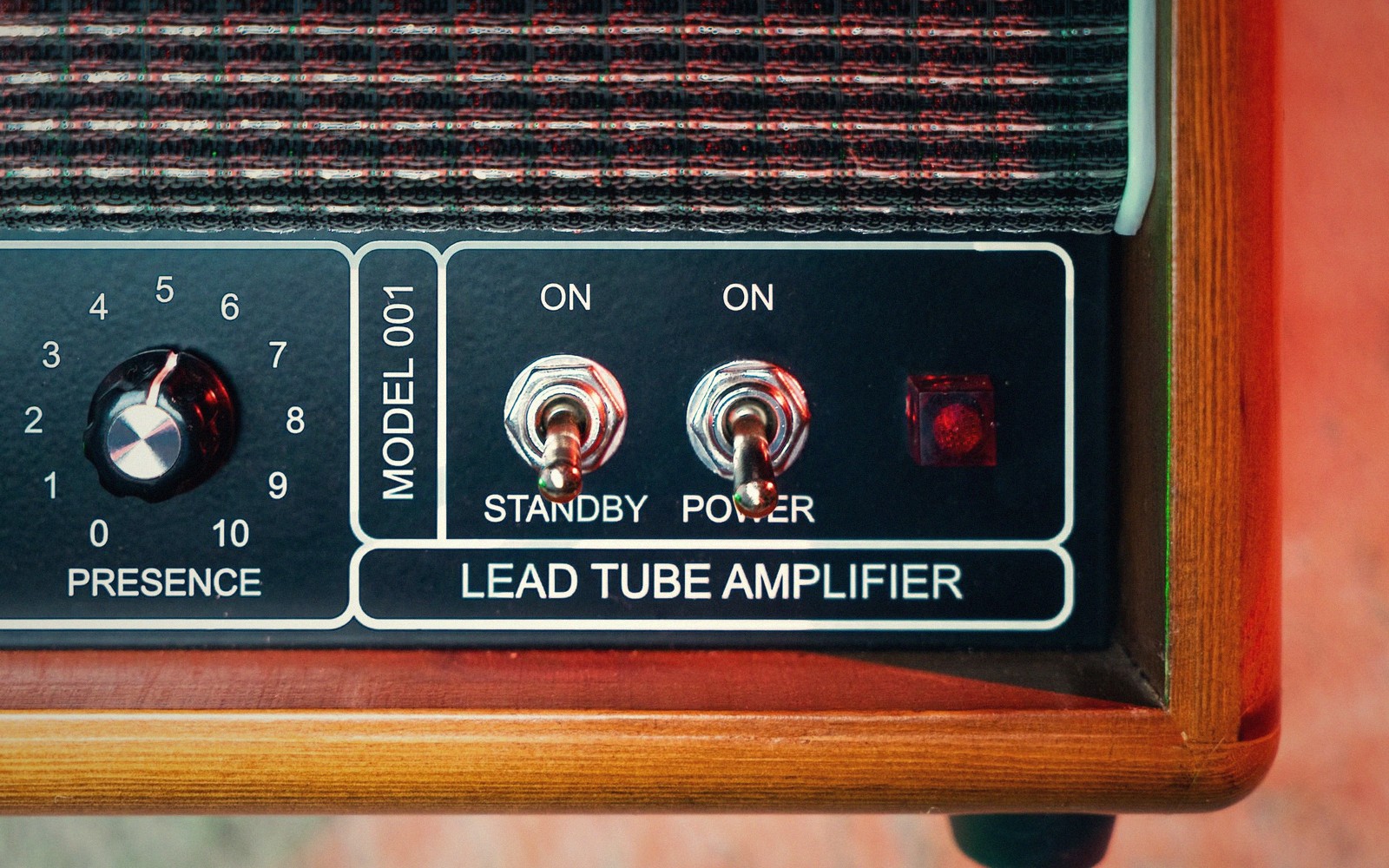
Amplifier watts, speaker sensitivity, impedance, distortion figures, frequency response curves — the numbers are real, but what they measure and what you hear are not always the same thing.
Power, Sensitivity, and the Decibel Arithmetic
Start with the number most buyers notice first: amplifier watts. It looks like a simple measure of force, and it is — but loudness does not scale the way you expect. Doubling the power adds only 3 dB to the sound pressure level. To hear something as twice as loud, you need roughly ten times the power. So the jump from 50 W to 100 W is a modest 3 dB at the listening seat; the jump from 50 W to 500 W is 10 dB, which is subjectively about twice as loud. This is not a trick or a manufacturer conspiracy — it is just how logarithmic scales behave, and once you have it in your head it immediately deflates the war between rival watt counts.
None of this means watts are irrelevant. They interact with the other number that determines how loud a system can play: speaker sensitivity. Sensitivity is measured in decibels of sound pressure level produced at one metre with one watt of input. An 88 dB/1W/1m speaker is one thing; a 95 dB/1W/1m speaker is a radically different proposition. That seven-decibel difference means the sensitive speaker needs only one-fifth the power to reach the same volume. Pair a low-sensitivity speaker with a low-power amplifier and you will hit the amplifier's ceiling — clipping, which sounds terrible and can damage tweeters — before you reach the listening level you want. Pair a high-sensitivity speaker with a high-power amplifier in a small room and you may find you are running the volume control at eight o'clock and still getting more than you want.
That seven-decibel difference means the sensitive speaker needs only one-fifth the power to reach the same volume.
The arithmetic is genuinely useful here, even if you do the sums roughly. A 90 dB sensitive speaker, driven to 90 dB SPL at the listening seat, needs one watt. Peaks in music can be 20 dB above the average level — so you want 100 W of headroom to handle those transients cleanly. A speaker at 84 dB sensitivity, six decibels less, needs four times as much power for the same job: 400 W to handle the same peaks without clipping. Sensitivity is the specification most often buried in small print and most worth excavating.
| Figure | What it describes | What it does not tell you |
|---|---|---|
| Power (watts) | How much the amplifier can deliver into a stated load. | Loudness. A 100 W amplifier is not twice as loud as a 50 W one — it is about 3 dB louder. |
| Sensitivity (dB/W/m) | How loud a speaker plays for one watt at one metre. | Quality. It tells you how much amplifier you need, nothing more. |
| Impedance (ohms) | The load the speaker presents, which varies with frequency. | A single number. The nominal figure hides the dips that actually stress an amplifier. |
| THD | Harmonic distortion added by the electronics. | Audibility. Below a certain point it stopped being the interesting number decades ago. |
| Frequency response | The range reproduced, ideally with a tolerance in dB. | Anything at all without that tolerance. '20 Hz–20 kHz' with no ±figure is marketing. |
Impedance: the Number Behind the Number
Speaker impedance is stated as a nominal figure — typically 4, 6, or 8 ohms — but that nominal value describes a single reference point, not the whole picture. Real speaker impedance is a curve that rises and falls with frequency, often swinging from below 4 ohms at some frequencies to 20 ohms or more at others. The nominal figure is, at best, a rough average.
Why does this matter? Because a lower impedance draws more current from the amplifier for a given voltage swing. An amplifier comfortable with 8 ohm loads may run hot, clip, or engage its protection circuitry into a 4 ohm load — or into the dips of a nominally 6 ohm speaker that drops to 3 ohms in the bass. Solid-state amplifiers generally handle low impedances better than valve amplifiers, which work most happily when their output transformers are matched closely to the load. If you are choosing between valve amplification and a speaker with a difficult impedance curve, the impedance dips matter more than the nominal figure.
Some manufacturers publish impedance curves in their specifications, which is genuinely helpful. Others give only the nominal figure. If a manufacturer states the minimum impedance as well as the nominal — "8 ohms nominal, 3.5 ohm minimum" — that second number is the one to check against your amplifier's capabilities. Matching amplifier to speaker is mostly about that minimum, not the headline.
THD: When Distortion Figures Are Useful, and When They Aren't
Total harmonic distortion — THD — expresses the additional harmonic content an amplifier adds to a signal, as a percentage. A figure of 0.01% means that one part in ten thousand of the output is distortion the amplifier introduced rather than signal it was given. Modern solid-state amplifiers regularly measure below 0.01% and often much lower; well-designed valve amplifiers typically measure higher, sometimes around 1%, but with a harmonic character that many listeners find less objectionable than the lower raw figure might suggest.
The limitation of THD as a single headline number is that it tells you almost nothing on its own. It is usually measured at one frequency (commonly 1 kHz), at one power level (often a fraction of rated power), under steady-state test-tone conditions — none of which resembles music. Distortion that rises sharply at high power levels, or that increases at low and high frequencies, will not appear in a clean headline figure. THD+N adds noise to the measurement, which is a better metric, and intermodulation distortion (IMD) — which measures what happens when two simultaneous tones interact — is more revealing still, since music is always multiple simultaneous tones.
None of this is to say low THD is meaningless. It is a sanity check: an amplifier posting 2% THD at modest levels has something wrong with its topology or execution. But comparing 0.003% to 0.0009% and expecting to hear the difference in a listening room is almost certainly an exercise in confirmation rather than perception. Below roughly 0.1% in an amplifier, other factors in the signal chain — the room above all, but the speakers too — are producing far more audible variation than the distortion figure. What THD mostly tells you at low values is that the design is competent. That is genuinely useful. It is not a fine-grained index of how the amplifier will sound.
Frequency Response: the Qualification That Changes Everything
"Frequency response 20 Hz – 20 kHz" looks comprehensive. Whether it means anything depends entirely on the tolerance that follows it. A speaker stating ±3 dB across that range is quite a different animal from one stating ±10 dB, yet both can carry the same headline claim. A ±3 dB window is considered tight for a loudspeaker; many real-world speakers measure ±6 dB or more in the bass, where the cabinet tuning, port resonances and room interaction all accumulate. Some manufacturers give no tolerance at all, which tells you to treat the claim as decorative rather than diagnostic.
For amplifiers and DACs, frequency response is usually a cleaner figure — electronics are far easier to measure flat than mechanical transducers — and deviations from flat across the audible band in a well-specified amplifier or converter are typically inaudible fractions of a decibel. The frequency response specification is much less revealing for electronics than for speakers, where it is probably the most important single measurement available, and even there it is an average — an on-axis measurement in an anechoic chamber, absent the room's contribution.
It is also worth knowing that frequency response does not capture everything about a driver's behaviour. A speaker can measure reasonably flat on-axis and still have significant problems at off-axis angles — which matters, because reflected sound in a real room comes from off-axis directions. Controlled directivity, and whether the speaker's off-axis response stays smooth as frequency rises, is something frequency response curves alone do not tell you unless the manufacturer publishes a full polar plot or directivity chart, which relatively few do as standard practice.
Reading Specs as a Sanity Filter, Not a Scorecard
Taken together, these specifications do a specific job well: they tell you whether a pairing is viable, and they screen out designs with obvious engineering problems. Sensitivity and impedance together predict whether an amplifier and speaker will work at all in a given room. THD filters out genuine outliers. Frequency response tolerance flags whether a speaker's maker is measuring honestly. That is genuinely valuable — you can build a system that is coherent on paper before you ever listen.
What the specifications struggle to capture is anything downstream of those basic viabilities: the particular texture of a cabinet's resonances, the way a tweeter disperses at 10 kHz, the character of a valve amplifier's upper midrange, the cumulative effect of the room the system will actually inhabit. A speaker can have exemplary measurements and still be unsuitable for a hard-walled, lively room. An amplifier with higher measured distortion than its rival may subjectively satisfy more — not because measurements lie, but because the measurements taken are incomplete.
The right approach is to use specifications to make a shortlist and rule out mismatches, then to let extended listening — ideally in your own room, with your own recordings — determine what stays. Specifications do not tell you how something sounds. They tell you how well it was measured, under what conditions, and whether the engineering is at least competent. That is a necessary foundation, and it is not nothing. But it is the beginning of the conversation, not the end of it.
They tell you how well it was measured, under what conditions, and whether the engineering is at least competent.
Nothing on this site is scored or ranked. Where a real maker or component is named, it is named because naming it explains something.