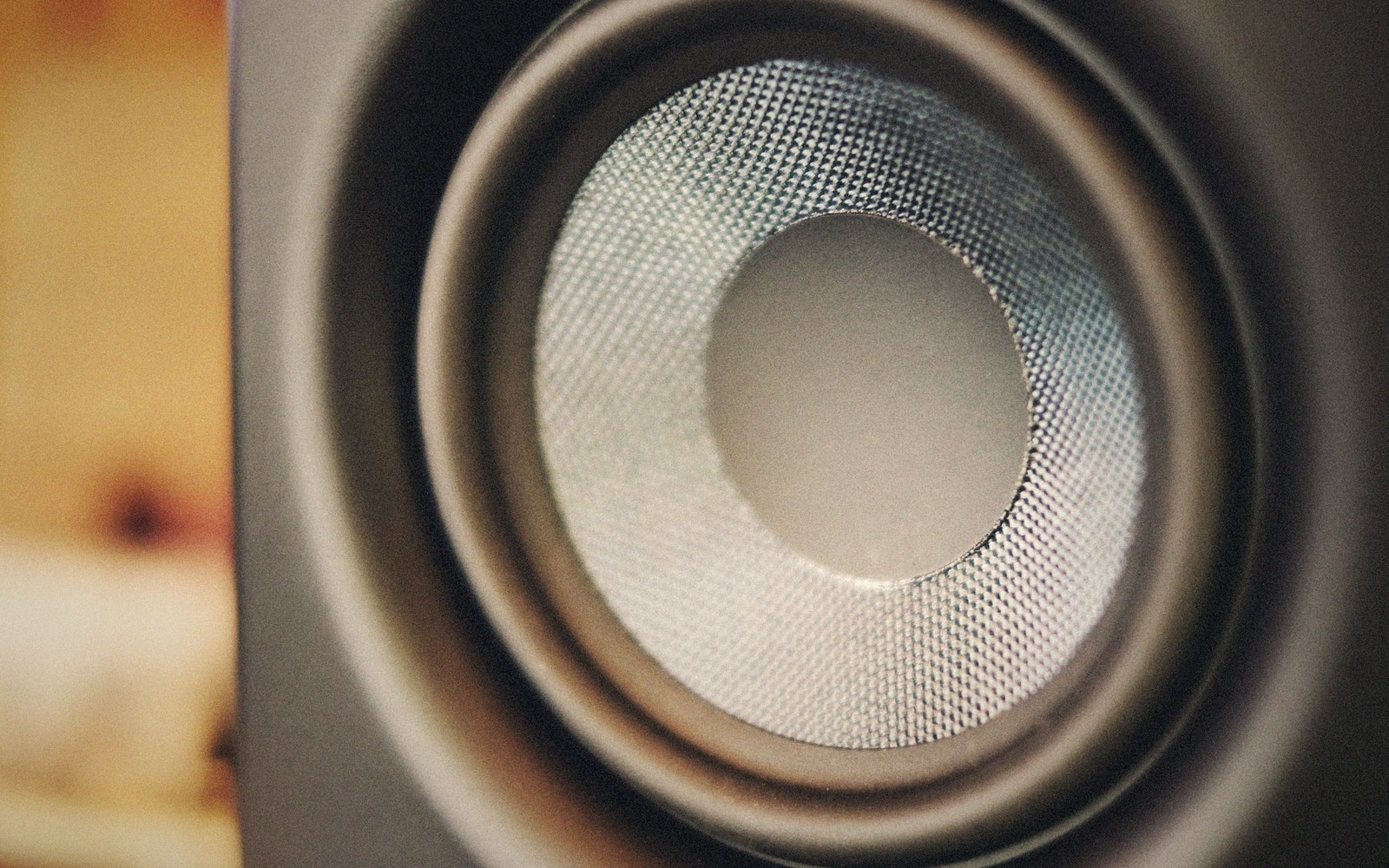
What each design trades away, and which trade suits a small room.
Four cabinets, four different bargains with physics
Every loudspeaker cabinet is a negotiation. The designer picks a size, a topology, a tuning, and in doing so accepts a set of trade-offs they cannot wish away. Understanding those trade-offs before you choose a speaker is more useful than any review score — because the trade-off that suits a large, well-damped room may actively fight you in a small, lively one.
Start with the two shapes. A standmount — also called a bookshelf, though a shelf is usually the worst place for one — houses its drivers in a compact enclosure typically placed on dedicated stands at ear height. A floorstander extends that enclosure toward the floor, adding internal volume, often a second or third bass driver, and the possibility of reaching lower frequencies without any external support. Neither is inherently superior. They solve different versions of the same problem.
| Sealed enclosure | Ported enclosure | |
|---|---|---|
| The cabinet | Airtight. | A tuned duct — a Helmholtz resonator. |
| Rolloff below the bass limit | About 12 dB per octave. | About 24 dB per octave below the tuning frequency. |
| What it trades | Gentle rolloff, strong transient control. | Extended bass output, obtained by resonance. |
What the cabinet shape actually trades
The floorstander's extra volume gives the woofer more air to work against, which means it can move lower without the back-pressure that compresses bass extension in small boxes. That physical reality is not marketing. What is worth interrogating is the claim that larger always means better in any given room. A floorstander that reaches comfortably to 30 Hz is producing energy at frequencies where the room itself dominates the outcome completely — the speaker's output interacts with your room's dimensions to create peaks and nulls that no amount of driver quality can overcome. In a small room, extended bass from a large cabinet can make things worse rather than better, adding boom that is structural rather than musical.
Standmounts, by accepting a more limited low-frequency extension, sidestep some of that problem by default. The bass they do produce tends to be better controlled, more even room to room, and easier to place. Their weaknesses are real: they cannot play as loudly before strain becomes audible, and in a large room they can sound thin and lightweight without a subwoofer to support them. But in a room under roughly four by five metres, a well-chosen standmount frequently sounds more composed than a floorstander twice its price.
Standmounts, by accepting a more limited low-frequency extension, sidestep some of that problem by default.
Sealed versus ported: a different set of choices
Cabinet shape is one axis; loading is another. Virtually all speakers use one of two approaches to managing the rear wave produced by the woofer: they seal the enclosure entirely, or they tune it with a port — a duct, usually at the front or rear — that acts as a resonant pipe and extends bass output below what the driver could produce alone.
A sealed enclosure is the more mechanically straightforward design. Bass rolls off gently, typically at around 12 dB per octave below the system's resonant frequency, and the driver stays under tight control throughout. Transient response — the ability to start and stop cleanly — tends to be strong, which is why sealed designs are often described as sounding tight or fast. The cost is sensitivity: for a given cabinet size, sealed speakers generally play less loudly per watt than ported equivalents, and their low-frequency extension is inherently more limited.
Porting is a technique formalized by Thiele and Small in the early 1970s, when researchers A. Neville Thiele and Richard Small published the mathematical framework still used today to model reflex enclosures. A properly tuned port acts as a Helmholtz resonator: near the port's tuning frequency, the air mass in the duct moves in phase with the desired output and reinforces it, pushing sensitivity and bass extension up together. The driver itself is partially unloaded around that frequency, which can reduce distortion in the bass region. The trade-off is behaviour below the tuning point: a ported speaker rolls off steeply — typically 24 dB per octave — and at high volumes the driver can move dangerously far without the back-pressure that would otherwise limit it.
Neville Thiele and Richard Small published the mathematical framework still used today to model reflex enclosures.
In practice, this means a ported speaker in a small room can excite room modes more aggressively than a sealed one at the same listening level, because it is delivering more energy at exactly the frequencies where rooms misbehave most. Blocking or stuffing a rear port is a common workaround, though it alters the tuning and usually raises the low-frequency rolloff point. A better solution is choosing a speaker whose port frequency is already appropriate to the room — which is one reason many compact standmounts designed for small-room use employ sealed loading, or port to the front where the output is easier to manage.
Matching the design to the room
The sensible hierarchy runs like this. Measure or estimate the room. Consider how close you will be sitting — near-field listening on a desktop system changes the calculus considerably, since the room contributes less at short distances. If the room is small and lively, extended bass extension will compound the problem rather than solve it; a sealed or lightly ported standmount is your natural ally. If the room is large and well damped, a floorstander earns its footprint.
None of this prevents a floorstander from working beautifully in a small room with careful placement and a little treatment. But placement and treatment are the active ingredient there — the speaker is succeeding despite its bass extension, not because of it. Knowing which design is working with your room and which is working against it is the kind of knowledge that does not expire.
Nothing on this site is scored or ranked. Where a real maker or component is named, it is named because naming it explains something.
- early 1970sThiele and Small publish mathematical framework for reflex enclosure design
A. Neville Thiele
Named in this piece
Australian engineer, co-developer of Thiele/Small loudspeaker parameters
Richard Small
Named in this piece
researcher who extended and published Thiele's work on vented enclosures