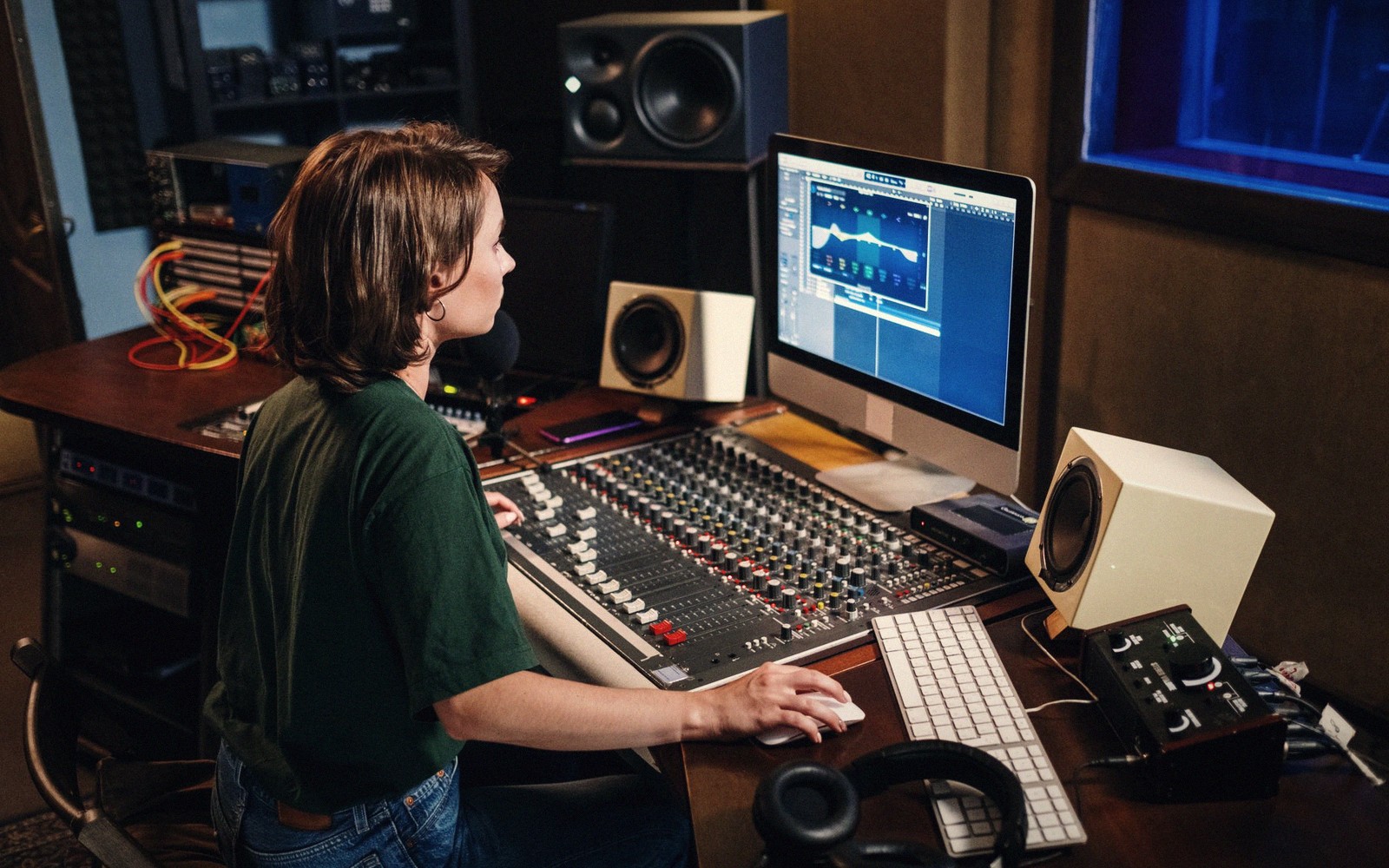
Near-field listening, and why it is the easiest good sound in the house.
Near-field listening is the easiest good sound in the house — if you set it up properly.
The Room Has Almost No Say
Most hi-fi problems are room problems. Bass modes pile up in corners, first reflections smear the stereo image, the listening seat lands on a null where a whole octave disappears. A full-range loudspeaker system in a typical room is a negotiation between the speaker you chose and the room you are stuck with, and the room usually wins below a few hundred hertz.
Put a pair of small speakers close — desk distance, roughly half a metre to a metre from your ears — and the geometry changes in your favour. The direct sound arrives at your ears long before the first reflection bounces back from anything. Your brain locks onto the direct signal. The room's early-reflection signature, which does so much to colour perceived tonality in a conventional setup, shrinks in influence. This is why studio engineers have worked at near-field monitors since at least the 1970s: not because they are fashionable, but because proximity delivers accuracy that a large room cannot easily provide.
There is a trade-off. At close range you are not seated in a blended, fully integrated soundstage — you are between two point sources. Imaging can feel wider than natural, and the sweet spot is genuinely narrow. Sit a few degrees off axis and you will hear it. That is a real limitation, not a myth.
At close range you are not seated in a blended, fully integrated soundstage — you are between two point sources.
What the Desk Actually Needs
A desktop system usually means a compact active speaker — a unit with amplifier and driver built together — or a small passive speaker with a matching integrated amplifier kept within reach. Either approach works; the active route removes the amplifier-matching question entirely, which is one fewer variable for a compact setup.
The surface matters more than most people expect. A hard desk reflects energy from the woofer straight back toward you, adding a broad colouration to the lower midrange. Placing speakers on decoupling pads — dense foam or purpose-made isolators — breaks the mechanical coupling between cabinet and desk, and the acoustic reflection is partly interrupted too. Small stands that tilt the tweeter toward ear height address the same problem another way. Neither fix is expensive, and both are worth trying before you consider anything else.
Bass extension at desk distances is limited, which is actually useful — a small sealed or lightly ported cabinet at half a metre works more honestly in the low end than a floorstander in a small room, where port tuning and room gain interact unpredictably. If you need more weight in the low registers, a small subwoofer placed on the floor under the desk — on the floor, not on the desk — can add extension without the worst of the surface reflection problem.
Source quality matters proportionally more in a near-field setup precisely because the direct signal dominates. Any noise floor in a DAC, any jitter artefact, anything a conventional system would quietly bury in room reflection arrives clearly. This is an argument for a decent USB DAC rather than a laptop's built-in output, not because measurements will reveal the difference on paper — often they will not — but because clean source engineering becomes the entire signal you hear.
Source quality matters proportionally more in a near-field setup precisely because the direct signal dominates.
Everything Else Follows From Proximity
The monitor reference position — equilateral triangle, tweeters at ear height, a little toe-in toward the listening position — holds in near-field just as it does at a distance. If anything, the geometry is easier to achieve at a desk because you can measure and adjust without moving furniture.
What you end up with, done well, is the nearest thing to a controlled listening test that a domestic space offers. No other room position in the house gives you this much direct sound and this little room. That is a significant advantage, and it is available to anyone with a desk, a chair, and half an afternoon.
Nothing on this site is scored or ranked. Where a real maker or component is named, it is named because naming it explains something.