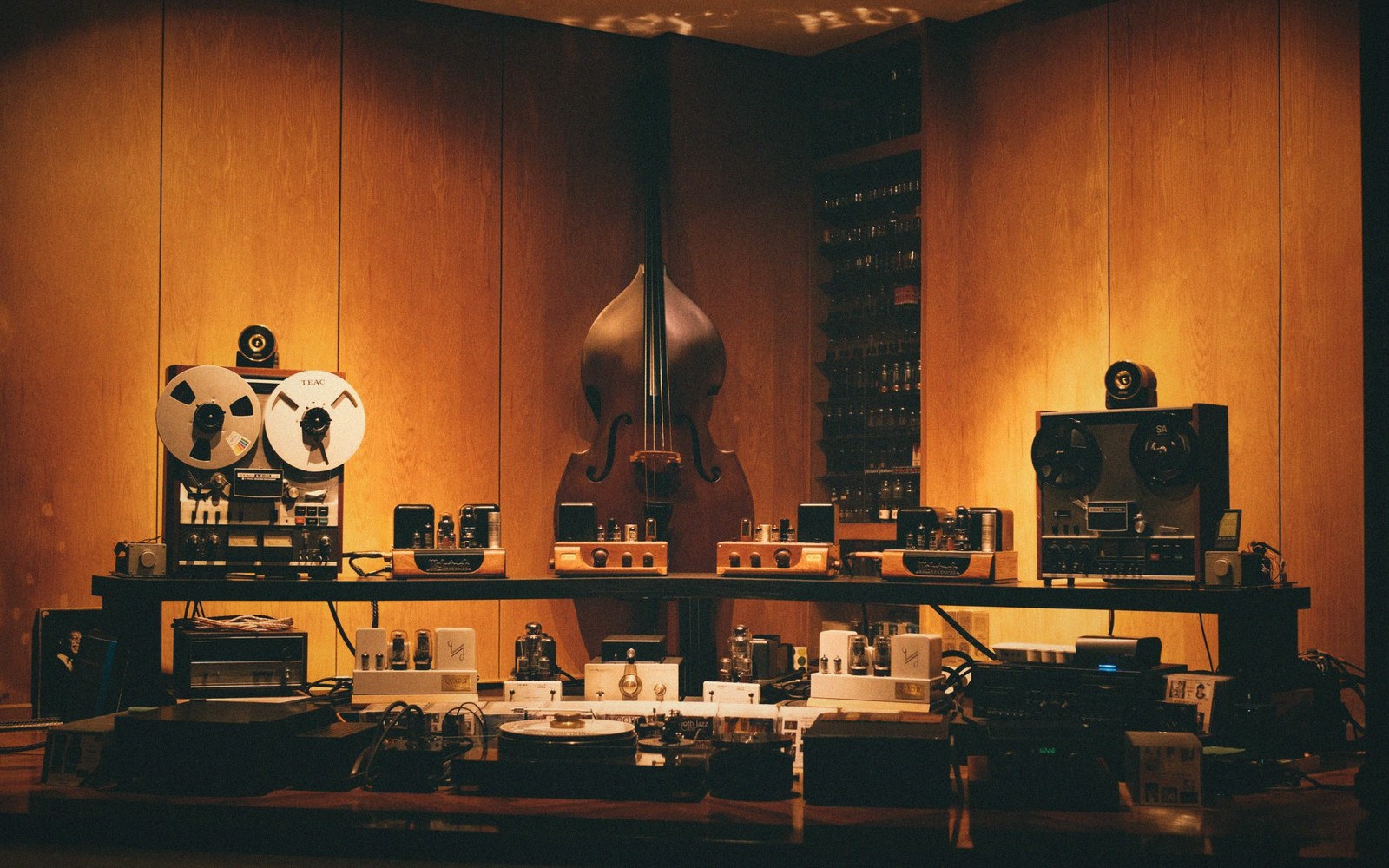
Source, amplification, speaker, room — and where the audible differences actually sit.
Every system is a chain — but not a chain with equal links
The conventional shorthand for a hi-fi system lists four stages: source, amplification, speakers, room. It is a useful map. What the shorthand leaves out is that these four stages do not contribute equally to what you hear. Two of them dominate everything. One matters, but less than its price tag suggests. One contributes least of all, and modern engineering has made it remarkably accurate. The room is so overwhelming that calling it a "component" feels almost too gentle. Understanding which is which saves money, saves frustration, and helps you identify where in your system the real leverage actually sits.
Start with what the chain is doing. A source reads or receives a signal. An amplifier raises that signal to a level capable of driving a loudspeaker. The loudspeaker converts electrical energy into mechanical movement of air. The room shapes every sound wave from the moment it leaves the cabinet until it arrives at your ear. Each stage hands off to the next, and any weakness in the chain is audible at the end of it — which is why the chain metaphor took hold. But chains can have one very weak link and several strong ones. Here, they can also have one link so dominant it effectively sets a ceiling for everything behind it.
| Stage | What it does | How big the audible difference is |
|---|---|---|
| Source | Turns a groove, a disc or a file into an electrical signal. | Small between competent modern sources. Large if one of them is broken or badly set up. |
| Amplification | Makes that signal big enough to move a cone, and controls it while it moves. | Moderate. Mostly a question of whether it has enough authority for your speakers. |
| Speaker | Turns electricity into air movement — the only stage that is also a mechanical object. | Large. This is where the money buys audible change. |
| Room | Returns most of that sound to you a few milliseconds later, reinforced and cancelled. | Largest, and the only stage you already own. |
The room is not part of your system — it IS your system
Below roughly 300 Hz, the acoustic behaviour of your listening room controls the frequency response you hear more than any component does. This is not a figure of speech. Room modes — the resonant patterns that form when bass wavelengths find dimensions they fit — can cause variations of 10, 15, even 20 dB at the listening position between adjacent low frequencies. No amplifier, no loudspeaker, and certainly no source introduces swings of that magnitude. If you want to understand why one note booms while the one just below it seems to vanish, room modes explain the mechanism plainly.
Above bass frequencies the room continues to shape what you hear through reflections, reverberation time, and diffuse energy. A bare, parallel-walled room with hard surfaces at every boundary will blur transients and smear stereo imaging in ways you can hear immediately on familiar recordings. Treatment — or simply soft furnishings, bookshelves, and rugs in the right places — reduces that smear without requiring a single equipment purchase. Placement within that room matters almost as much as the room's own character: moving speakers a foot from a rear wall can remove a bass peak that has bothered you for years.
The practical consequence is blunt. Spending heavily on components while leaving a problematic room untouched is spending in the wrong order. Fixing the room's gross acoustic problems — not necessarily with specialist panels and a consultant, but with thoughtful placement and basic absorption at first reflections — will change what you hear more reliably than most amplifier or source upgrades. The room is the component that audiophiles most consistently underestimate.
Loudspeakers introduce the largest component-level variation
Once you step from the room to components proper, loudspeakers introduce the most audible variation of the four stages. This is measurable and repeatable. Different speaker designs measure differently in ways that translate directly to what you hear: frequency response varies across audible octaves, dispersion patterns differ substantially, cabinet resonances vary, crossover designs impose different phase relationships. Two loudspeakers of similar price from reputable makers can sound genuinely unlike each other in ways that are audible to almost anyone on first listen with familiar music. Swapping amplifiers of similar quality, by comparison, often produces differences that are smaller, later-apparent, and harder to isolate from expectation.
Several mechanisms explain why. A loudspeaker's efficiency — how much sound pressure it produces from a given watt — determines the system's dynamic range ceiling. Its impedance curve affects how hard it works the amplifier. Its cabinet and driver behaviour together determine what the ear receives over the full audio band. The differences between a vented design and a sealed one in bass timing, the differences between a soft-dome tweeter and a metal one in high-frequency character, the vast differences between a small standmount and a large floorstander in low-frequency extension — these are not subtle. The guide to speaker types covers what each design trades away, and those trades have real audible consequences.
The guide to speaker types covers what each design trades away, and those trades have real audible consequences.
This is why the received wisdom in loudspeaker-amplifier spending allocation leans toward the loudspeakers. Not because amplifiers are irrelevant — they are not — but because the speakers impose the largest audible signature on the system, and because matching them correctly to the room matters more than refining what feeds them, up to a point.
Amplification matters, but less than the box it comes in
Amplifiers occupy the third tier — genuinely important, but their audible contribution is smaller than loudspeakers produce and dramatically smaller than the room imposes. A capable, well-matched amplifier running comfortably within its linear operating range and into a sensibly sensitive speaker will introduce very little of its own character. The reason so many amplifier comparisons sound dramatic in dealer demonstration rooms and far less dramatic at home is that the room and speaker change was always doing most of the work.
What genuinely matters in amplification is matching: enough output to drive your speakers to a satisfying level in your room without clipping, and an output impedance that sits sensibly below your speaker's load. An amplifier asked to drive a difficult impedance loudspeaker with insufficient current will sound compressed and lack dynamic ease. An amplifier producing more than enough power for the task in hand will tell you almost nothing about itself in normal use. The guide on how much amplifier you actually need covers the real calculation; the short version is that sensitivity and room size decide it, and many people own far more watts than the physics requires.
Where amplifier character is audible — and it sometimes is — it tends to manifest at the frequency extremes, at high listening levels, or with demanding speaker loads. A high-output-impedance valve amplifier driving a speaker with a wildly variable impedance curve will produce response changes you can measure and hear. These effects are real. They are also predictable and avoidable with sensible matching. Within the range of well-designed solid-state amplification that is correctly matched and not driven into clipping, audible differences are modest. Meaningful, sometimes — but modest.
The source contributes least, and modern sources are genuinely good
This may be the most counterintuitive claim in the chain. The source — whether a streaming device, a DAC, a CD transport, or a turntable — sits at the beginning and feeds everything downstream. Surely it sets the quality ceiling? In one narrow sense, yes: a source cannot add information that was never in the recording. But modern digital sources, operated correctly, perform with vanishingly low distortion and noise. The gap between a well-implemented budget DAC and a very expensive one is the smallest audible gap in the entire chain.
The gap between a well-implemented budget DAC and a very expensive one is the smallest audible gap in the entire chain.
The qualifications matter. "Operated correctly" means bit-perfect playback with a stable clock and adequate output level — conditions most modern streaming devices meet without fanfare. A poorly implemented device with a noisy power supply may introduce audible artifacts, particularly in a revealing system. And analogue sources like turntables operate by entirely different mechanisms: a cartridge produces real, measurable variation across models, and setup quality has an enormous effect on what you actually get from vinyl. But even here, the variation a cartridge introduces is, in most systems, smaller than the variation the room introduces every time you change a boundary condition.
The marketing pressure around sources — particularly around high-resolution formats, cables feeding digital transports, and audiophile streaming devices — runs well ahead of what controlled listening and measurement typically support. This is not a reason to buy poorly; it is a reason to be appropriately sceptical of large expenditure at the source end of the chain until the room, the speaker placement, and the speaker-amplifier match are all in good order.
Getting the order right
The practical architecture that falls out of all this is not complicated. Deal with the room's gross problems first — placement, basic treatment, reflection management. Choose loudspeakers for your room's size and character, and for the kind of music you listen to. Match an amplifier to those speakers with enough headroom to run comfortably. Then, and only then, refine the source. This is not the order in which most people assemble systems, because sources and amplifiers are sold in glamorous boxes and rooms are owned before any of this begins, which makes them psychologically invisible. But it is the order in which audible improvements accumulate.
The chain metaphor is true. What it does not say loudly enough is that one link in that chain is architectural, one is mechanical and acoustic, one is electrical, and one is a conversion that modern engineering performs with impressive accuracy. Knowing where the leverage lives is not cynicism about the hobby. It is the fastest route to a system that genuinely sounds like music.
Nothing on this site is scored or ranked. Where a real maker or component is named, it is named because naming it explains something.